The new kitchen is in, the bathroom is tiled, the painters have packed up. And yet every surface in the apartment wears a gray film, the closets are full of fine dust, and the floor feels gritty underfoot. Post construction cleaning in NYC is the final clean that takes a home from finished to livable after a renovation, a gut job or a smaller repair.
Deep Cleaning Company NYC is an independent referral service, not a cleaning company. When you send the form, your request goes to an independent New York City cleaning company that scopes the job, quotes it and does any work.
This page covers what that final clean usually includes, how it fits with the contractor’s own cleanup, why New York’s older buildings call for extra care with dust, and how to describe the job so an independent cleaning company can plan it.

Why renovation dust is its own kind of job
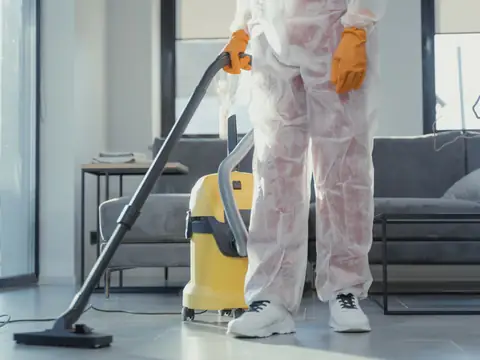
Construction dust is finer than household dust. It travels past plastic sheeting, settles on top of door frames and inside cabinets, sticks to fresh paint and window tracks, and keeps coming back for a while because it rises again every time someone walks through. Dry dusting and sweeping just move it around. Post renovation cleaning works top to bottom with vacuums and damp cloths so the dust is picked up, not pushed into the air.
The EPA’s guidance for cleaning up after a renovation in an older home shows the method clearly. Its “Clean One More Time” steps, for use before family members go back into a work area, are:
- “Mop uncarpeted floors thoroughly;”
- “Clean walls with a HEPA vacuum or a damp cloth;”
- “Thoroughly vacuum all remaining surfaces and objects, including furniture and fixtures, with a HEPA vacuum; and”
- “Then wipe down all surfaces with wet disposable cleaning cloths until the cloths are clean.”
That sequence (vacuum with a HEPA filter, then wet wipe until the cloth stays clean) is a good standard to discuss with any company you hire for a final clean, in any building.
The contractor’s cleanup and the final clean
Renovation contracts usually include some cleanup. Read yours, because the line between the contractor’s work and the cleaning company’s work decides what you ask for.
| Contractor’s cleanup (check your contract) | Final post construction clean | |
|---|---|---|
| Debris and waste | Removing construction debris, offcuts and packaging from the site | Not a cleaning task; the space should be clear first |
| Paint and dust control | In pre-1978 homes, lead-safe work practices by a certified renovator (EPA RRP) | Not a substitute for the contractor’s lead-safe cleanup |
| Rough clean | Sweeping and vacuuming the work area at the end of the job | A detailed clean of every surface, inside and out |
| Surfaces and fixtures | Usually not | Cabinets inside and out, counters, appliances, fixtures, switches, outlet covers, vents |
| Windows and trim | Usually not | Sills, tracks, frames and the inside of the glass within safe reach |
| Floors | A broom clean | Vacuumed and washed, edges and corners included |
Renovation finished? Tell us what was done and which rooms were affected, and send the form to reach an independent NYC cleaning company.
Older New York buildings and lead dust
Much of New York’s housing is old, and old paint matters when walls, trim and windows are opened up. The EPA says: “Any renovation, repair or painting project in a pre-1978 home or building that has lead-based paint can easily create dangerous lead dust.” HPD adds that lead paint is often found in paint “used in apartments and residential buildings in New York City built before 1960.”
- The renovator’s duty. EPA’s RRP Rule “requires that anyone paid to perform work that disturbs painted surfaces in homes, childcare facilities and preschools built before 1978 be certified” in lead-safe work practices. If you rent, your landlord “must comply with the RRP Rule when performing work that disturbs paint.”
- NYC’s own law. Local Law 1 of 2004 requires owners of buildings built before 1960 (and some built before 1978) to presume paint is lead-based and address lead-based paint hazards, particularly where a child under six lives.
- Testing. The EPA notes you can hire “a certified lead dust sampling technician, lead-based paint inspector, or lead-based paint risk assessor to perform post-renovation dust-lead testing to confirm your work area is clean.”
Important
A cleaning company’s final clean does not replace the contractor’s lead-safe cleanup or a dust-lead test. In a pre-1978 home, ask your contractor about lead-safe practices before the work starts, and keep children away from the area until the cleanup is done. If a landlord’s work is creating dust that is not contained, HPD says a tenant can file a complaint online or call 311.

What a post renovation clean usually covers
Like any deep clean, the scope is what you agree with the company in writing. These are the areas most people list:
- Ceiling corners, light fixtures and the tops of door frames, then walls and trim.
- Inside and outside of every cabinet, drawer and closet, where dust collects first.
- Counters, backsplash, sinks and fixtures, with care for new surfaces.
- Appliances inside and out, including the range hood and filters.
- Bathroom tile, glass, fixtures and the vanity.
- Vents, grilles, radiators and outlet covers.
- Window sills, tracks, frames and inside glass.
- Floors vacuumed, then washed, including edges and corners.
Timing the clean
Book the final clean for after the trades are done in the rooms, not while they are still sanding or painting. If work is still going on elsewhere in the home, say so: dust will travel, and the company may suggest keeping doors closed or cleaning in stages. Ask the contractor to finish removing debris first so the cleaners can reach every surface.
New finishes can be delicate. Tell the company what was installed (stone counters, new wood floors, fresh paint) so it can choose suitable products. The EPA’s general advice holds: “Follow label instructions carefully” and “Never mix household care products unless directed on the label.” If the work leaves you with half-used solvents or strong cleaners, DSNY’s SAFE Disposal events take them, or see nyc.gov/safedisposal.
How to describe a post construction job
- What was done: a kitchen, a bathroom, a full renovation, painting, floors.
- Which rooms were affected and which were closed off.
- Roughly when the building was built, if you know, and whether the contractor used lead-safe practices.
- Whether the debris is gone and the trades are finished.
- New finishes that need care: stone, new wood, fresh paint, new appliances.
- Building rules: elevator booking, service entrance, the hours work is allowed.
Give the company the full picture in plain words. A one-bedroom with a new bathroom is a very different day from a whole floor-through after a gut renovation, and the company can only plan the people and the time if it knows which one it is walking into.
Post construction cleaning across the boroughs
Renovations run from brownstone floor-throughs in Brooklyn to co-op kitchens in Queens and condo bathrooms in Manhattan. Building rules can be strict after construction: elevator bookings, service entrance hours, and protection for hallways. Check with your building before the day. Requests come in from every borough, including searches for Brooklyn post construction cleaning and post construction cleaning in Manhattan; see deep cleaning services in Brooklyn, deep cleaning service in Queens and deep cleaning in Manhattan.
If the renovation was mostly the kitchen, the kitchen deep cleaning guide lists every surface. If the rest of the home also needs a reset, ask for apartment deep cleaning at the same visit, or heavy duty cleaning if it was a gut job on a neglected place.
Describe the renovation, the rooms and your building’s rules in the form. An independent NYC cleaning company can get back to you about the final clean.
Questions people ask
What is post construction cleaning?
The detailed clean after renovation or repair work: fine dust removed from every surface top to bottom, inside cabinets and closets, fixtures, vents, windows and floors, so the space is ready to live in.
Does my contractor’s cleanup count?
It usually covers debris and a rough clean of the work area. Read your contract. In a pre-1978 home a paid renovator must also follow lead-safe work practices under the EPA’s RRP Rule; a final clean does not replace that.
Is post renovation dust dangerous?
Dust from disturbing old paint can contain lead. The EPA says renovation in a pre-1978 home with lead-based paint “can easily create dangerous lead dust.” A certified technician or risk assessor can do post-renovation dust-lead testing.
When should I book the final clean?
When the trades have finished in the rooms to be cleaned and the debris is out. If work continues elsewhere in the home, tell the company so it can plan around the dust.
Can the cleaners remove paint splatter and stickers?
Ask when you describe the job. Light marks and labels on glass and fixtures are often part of a final clean; anything that means scraping painted surfaces in an older building is not a cleaning task.
Who does the cleaning?
An independent New York City cleaning company. Deep Cleaning Company NYC is a referral service and does no cleaning itself.